Tuesday, January 19, 2016
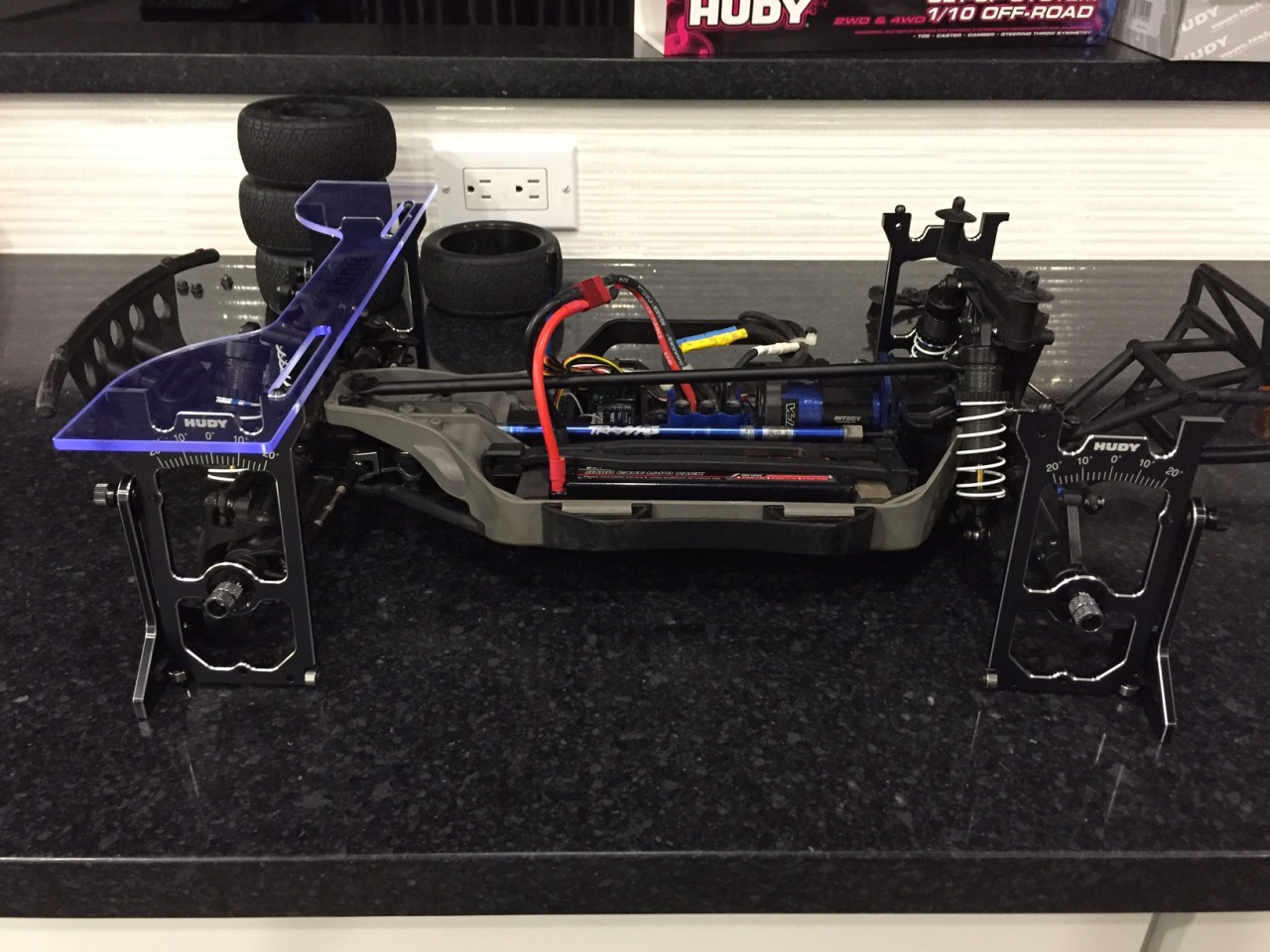
HUDY 1/10 off-road setup station review

Monday, January 18, 2016
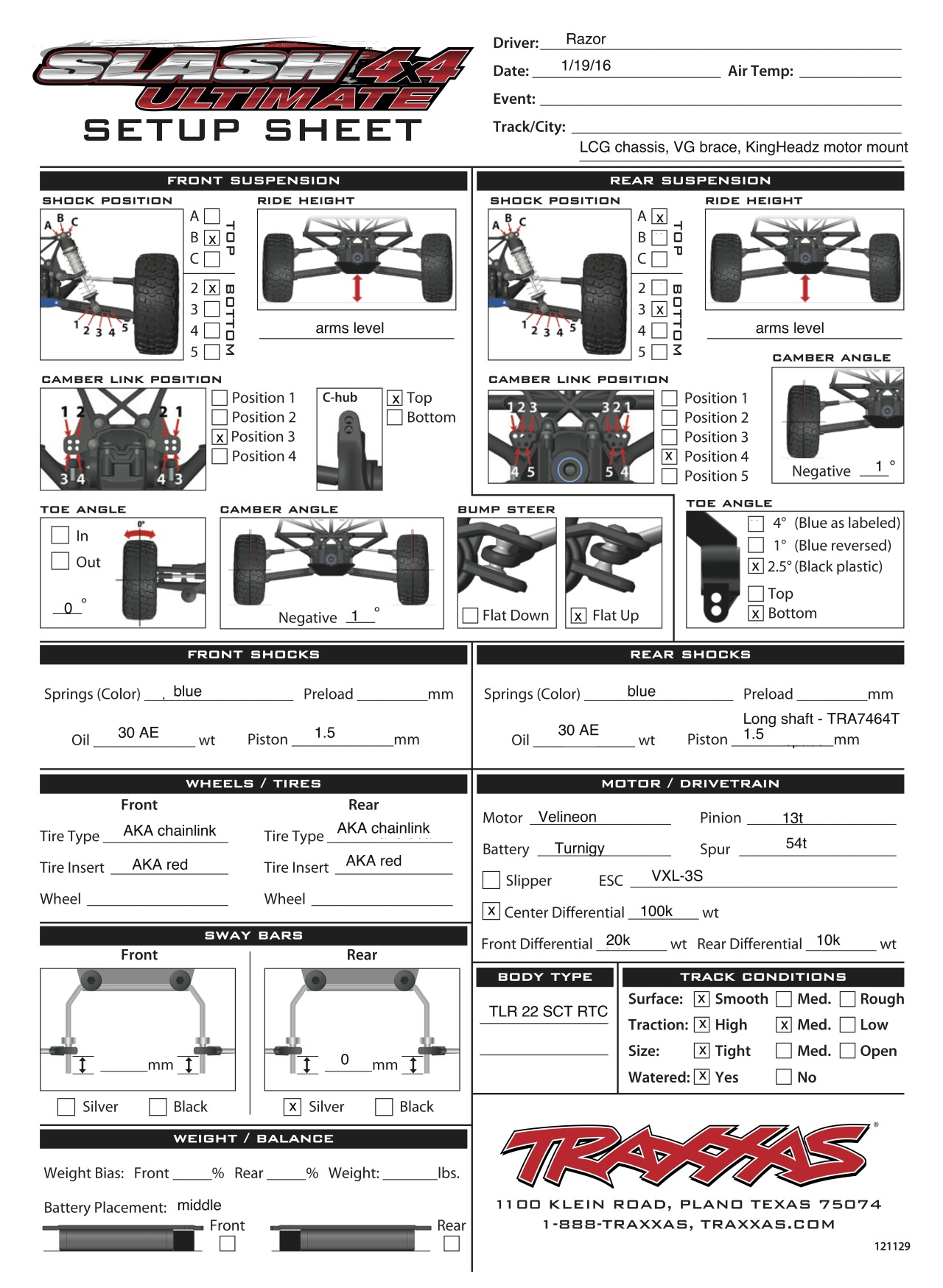
I made a shock package change, going with 1.5mm pistons and 30wt fluid to see if I can get some more shock pack. Bench testing, it seems to have less damping than the 1.6/35wt combo, but we’ll find out at the track this week. I also added more camber gain to the front/rear and switched to clay compound Chainlinks. Grip is not as good as the soft compound Handlebars I used to use, but they should pack up with dirt less and should have decent grip once they’re broken in and sauced.
I might need to go to 32.5wt fluid, we’ll see. Also am using 20k diff front and 10k diff rear, and that seems about right. Any lighter and I would probably suffer on the drive a bit. Steering seems fine. I am running the front holes on the caster hubs though for a sharper steering angle.
Sunday, January 10, 2016
Slash 4x4 diff rebuild
I rebuilt all 3 diffs this weekend and figured out a few things that might help out. The basic process was:
Get the rebuild kit (TRA5381 or TRA6884 for front/rear or center).
- Remove the diff. For the front/rear, take off the bumper (4-5 bolts), take off the outdrives (2 1.5mm grub screws), then remove the two bolts that split the bulkhead in half. Couldn’t be easier to get to them.
- Take off the bearings (check/replace while you’re at it).
- Remove the 4 bolts that hold the gear onto the diff housing.
- Disassemble the whole diff and clean all the old metal parts with motor spray, WD-40, or your degreaser of choice. Throw away the non-metal parts.
- Pre-thread the 4 bolts into the new housing. This is actually pretty important, you don’t want to apply a lot of torque when you’re reassembling. By pre-threading them, this helps you tighten the bolts nice and easy later on during assembly.
- Coat all of the blue X-rings and the gasket with diff fluid, then put in all of the outdrives and spider gears. Take care to note that the outdrive that goes into the housing has an extra metal gasket the gear side does not.
- Put on the thin rubber gasket, making sure everything is lined up.
- Put on the big metal gear, again making sure all of the holes are lined up. There are some small guide nubs in the housing that mate to the gear, so it should fit together nicely. If it doesn’t, take it off and realign the gasket!
- Tighten the 4 bolts by holding onto the plastic diff housing. Try not to hold onto the gear while you’re tightening, as this will twist the gasket. The bolts should be tightened just enough till you feel resistance – you don’t need to crush them.
- Put the diff back in, and reassemble the car. Presto!
Once you go Slash you never go back
I spent Saturday evening at the track tuning my Slash 4x4. I also ran into Tony and his son and checked out their awesome new Slash 4x4 Ultimates. It was nice to see a new car actually, as I got to check out the play in their A-arms. I figured out my rear arms are a bit worn out and sloppy, even though they’re not broken!
We have a high speed sweeper where I was constantly losing the rear (front planted). Moving the shocks inward helped a little by adding a more progressive spring rate. I also added some more rear camber gain by moving the rear camber links to the outside hole on the shock tower.
But the trick that helped the most was inducing a little more body roll by switching back to the silver rear sway bar. I have so much traction now, I’m getting a tiny bit of front end push!
I also rebuilt all my diffs. The rear was too slow and the front was OK. Went with 20k front, 10k rear and 100k in the center, will test that out tomorrow. Look for lots of Slash updates as I get this thing dialed.
Of course they’re going to change the track layout again in 2 weeks, so I may have to switch things up yet again, but it’s been a ton of fun tuning the Slash. It’s definitely my favorite part of the hobby.
On the downside, it seems like my Traxxas receiver went out in the car, it was behaving very erratically and has gotten worse and worse. I had an extra Futaba receiver for my 3PL radio, so I threw that in and hopefully that fixes it. Else it’s the ESC, which would suck!
Friday, January 8, 2016
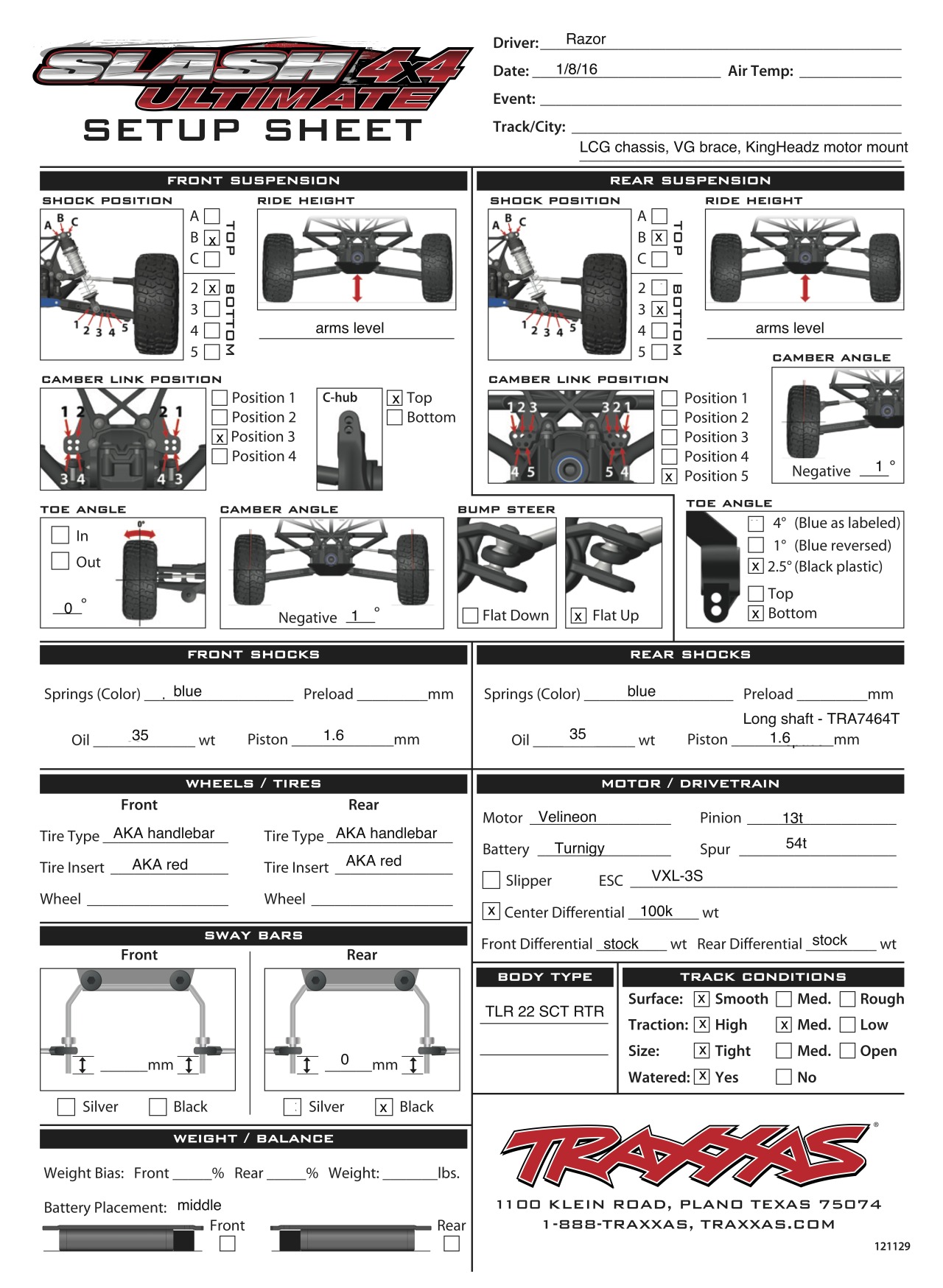
I took the Slash to the track today and messed around a little bit and noticed some stuff was not quite right. Moved the rear shocks around a little bit to get more of a progressive rate to the springs to help in the high speed sweeper we have here. I’ve also gone to 35W front and rear with blue GTR springs all around.
Wednesday, January 6, 2016
TLR 22T 2.0 review

I’ve got one more car in my possession that I haven’t reviewed yet, and that’s the TLR 22T 2.0.
I’ve had this car for about 3 months now, and it’s the first car I bought used. While I got the car pretty cheap ($150 roller plus lots of extra aluminum parts), it still cost me quite a bit to fix a bunch of things that were done wrong. I’m not super anal about how my cars are built, but the previous owner definitely did a bunch of things wrong that I had to correct, so overall I didn’t save much over a new kit. It’s pretty much turned me off from buying a used kit again, and when you consider the wear the plastics go through after a normal season, you can see that for the most part a new kit makes more sense.
But enough about my personal history of the car, let’s go onto the review.
Overview
The TLR 22T 2.0 was the last of the 2.0 kits, and features all of the upgrades to that point. You get the bellcrank steering, revised caster and steering blocks, improved shocks with X-rings, and a new slipper clutch. Like all of the 1.0 and 2.0 kits, it can be built as rear motor or mid-motor, and includes all of the parts (and both bodies!) to make that happen. At $299, it’s a pretty good value and is the cheapest of the 2.0 kits, despite having the most parts in the box.
TLR tends to come out with a buggy first, then the short course, and finally the stadium truck. So it’s pretty much the fully realized evolution of the 2.0 generation.
Build: 8
I didn’t build the kit, but I have built the SCT 2.0 and swapped chassis and diff builds and shock builds as well as replace the steering bellcranks, so every part of the kit has been disassembled and reassembled. The kit for the most part works fine, but I have found errors in the manual (wrong part #’s, wrong dimensions, etc.) and the sheer number of hex drivers that you need (0.05″, 1.3, 1.5, 2.0, 2.5) is somewhat annoying. The steering system is a bit fiddly with the bearing washers and the way it threads together, and the rear end is a bit fiddly with the way the toeblocks are held in with tiny screws. It’s not bad, but I don’t find it to be an elegant design. I’m sure the design goal of rear and mid-motor makes for a more complicated design.
Performance: 9
The handling of the car is it’s best attribute. You get amazing traction, it drives predictably, it’s a very stable and forgiving platform. I do find mid-motor to be fairly sensitive to setup, a 1mm change makes for a BIG difference in this car, and can turn it from terrible to amazing (or vice-versa!) with minute changes. The kit setup is pretty good, most people use a brass rear pivot block and slightly lighter shock oil in the rear. I also ended up going up 1mm on the front and rear shock tower ballstuds, and the car drives great.
It does tend to have a fair amount of body roll – I’m not sure if it’s the long arms, or the inline battery or what exactly, but my car is setup pretty well and I don’t think you can completely tune this out. I do have it setup for a bit of body roll to get traction, so it may be more setup than anything else.
My primary performance issue with the car is that it’s a little behind the Associated truck in terms of a 3-gear transmission. I love the way the B5M drives with a 3-gear, and the lightened drivetrain definitely makes a difference in acceleration for spec classes (we race 13.5 here). It’s also not a light car (my car weighs about 1930 grams), but pretty much every car in this class weighs a lot.
It also would be nice if you could mount the battery transversely – I find the car to nose down a fair amount jumping. This is with an in-line shorty, I think a transverse battery would help the weight distribution a fair amount and help the jumping.
Durability: 8
I have broken a few parts on the car. The slipper spring also tends to wear out in this car – it’s a common problem with all of the 22 cars, the spring is just kind of weak. Not that big a deal in spec classes, but with a mod motor you need to crank it down significantly. I have also stripped a front and rear camber block, so I recommend you use longish ballstuds and put grub screws in the holes next to the ones you use. This helps keep the ballstuds from ripping through the holes in a crash.
Value: 9
At
$299, the truck is a pretty good value, especially considering you get all of the parts to go mid or rear motor. Nobody really drives the car rear motor, so I’m not sure that value is fully realized as opposed to the T5M which costs $20 less. But the parts are high quality, the shocks are second to none, and you get a lot in the box.
Support: 8
TLR support is good, Frank Root has a strong online presence and will provide a lot of information to racers. It’s not as strong as Associated (nobody’s is!), but it’s probably the second most amount of information you get out.
Dislikes
I find the build of the car a little fiddly, and the 4-gear transmission is a bummer, but the car drives awesome and handles amazingly. The slipper is not as good as the Associated one IMO and can be frustrating for newer drivers. I had a lot of issues with my 22SCT slipper, but the 22T is lighter and with a spec motor not a big deal.
I also find the steering to develop slop a bit quickly IMO. Crashing a lot doesn’t help, but the plastics do tend to wear out a bit quicker than Associated in my experience.
Conclusion
The car is a very easy and forgiving car to drive, it’s a good value, and is definitely capable of winning races. My 11-y.o. son finds it easier to drive than my Slash, even though it’s 2WD. It just a very smooth and predictable car.
I’ve driven a well setup T5M and find the T5M to be more of an aggressive, quicker steering vehicle, while the 22T 2.0 is more a smooth, easy to drive vehicle. They have different personalities, and you really can’t go wrong with either of them depending on what you’re looking for.
Recommended.
Saturday, January 2, 2016
Sportsman
With the holidays in full swing, I was able to get out for another race. This time I decided to race the B5M and the 22T2.0 in 17.5 and 13.5 classes on a very busy night at the local track.
To my horror, when I got to the track I realized they had changed the layout and I had no time on the new layout at all. I got in maybe 10-15 laps with the cars to make sure everything worked, then went straight into qualifying.
It was pretty tough driving the Losi, I don’t drive it much and the setup is not quite there (mostly tire issues I think). I basically qualified last and entered the B-main in last and finished one ahead of a guy who crashed and popped a ballcup. Not a great result and shows I definitely need to get some more practice and setup time with the truck.
Things went much better with the B5M lite. First qualifier I TQ’d, the second one I nose-planted off the start (lol!) and started the A-main 3rd. The race went pretty smoothly, I had to be turn-marshalled twice, but finished on the podium. Pretty happy with my result, this was actually my first official Sportsman race. The previous one I qualified too high and had to race Expert, lol.
Subscribe to:
Posts (Atom)