Sunday, April 3, 2016

Sanwa update

Those of you who have been following RC news the last couple of days have probably heard that Airtronics is going under.  I didn’t know exactly who they were, but they were basically the US brand of Sanwa, and that name is going away.

So I guess I own a Sanwa MX-V and Sanwa MT-4S.

I’ve been using the MX-V a bit more lately, it’s the radio I usually pair with my TLR 22T2.0.  I find the wheel overly stiff, but other than that it is a fantastic radio and I have to give it the nod over the Futaba 3PL.  Even if I were just bashing, I’d go with the Sanwa for the better precision and fit and finish.  I still use the Futaba with my Slash, but am seriously thinking of converting it over to the MX-V also.  We’ll see…  at this point I am quite a Sanwa fan.

Slash steering slop

There was a cool new thread on the Traxxas forums a week ago that piqued my interest.  Those of you who have a Slash 4x4 have noticed the excessive steering slop.  New plastics help, but most of the slop comes from the shoulder screws in the C-blocks and the steering linkage, and a smart guy on the forums had a fix.

Here’s the thread:

https://traxxas.com/forums/showthread.php?9056238-Steering-slop-reduction-mod

I took it a bit further and expanded on his ideas.  The main mod is to use 3x6x2.5 bearings everywhere there are shoulder screws, and then replace the shoulder screw with an M3 screw.  For the steering linkage, I’m using flanged 3x6x2.5 bearings I got from Avid RC, and some 3x5x4mm Serpent spacers to take up the excess space.

For the C-hubs I’m using the same flanged bearings with an additional 3x6x2.5 bearing in the bottom and a 3x5x2mm spacer on the top.

Check out the thread for more pictures and a more detailed description of the mod.  Overall, I’d say this cut out about 80% of the excess steering slop I had and cost less than $20 in parts!

Thursday, March 17, 2016


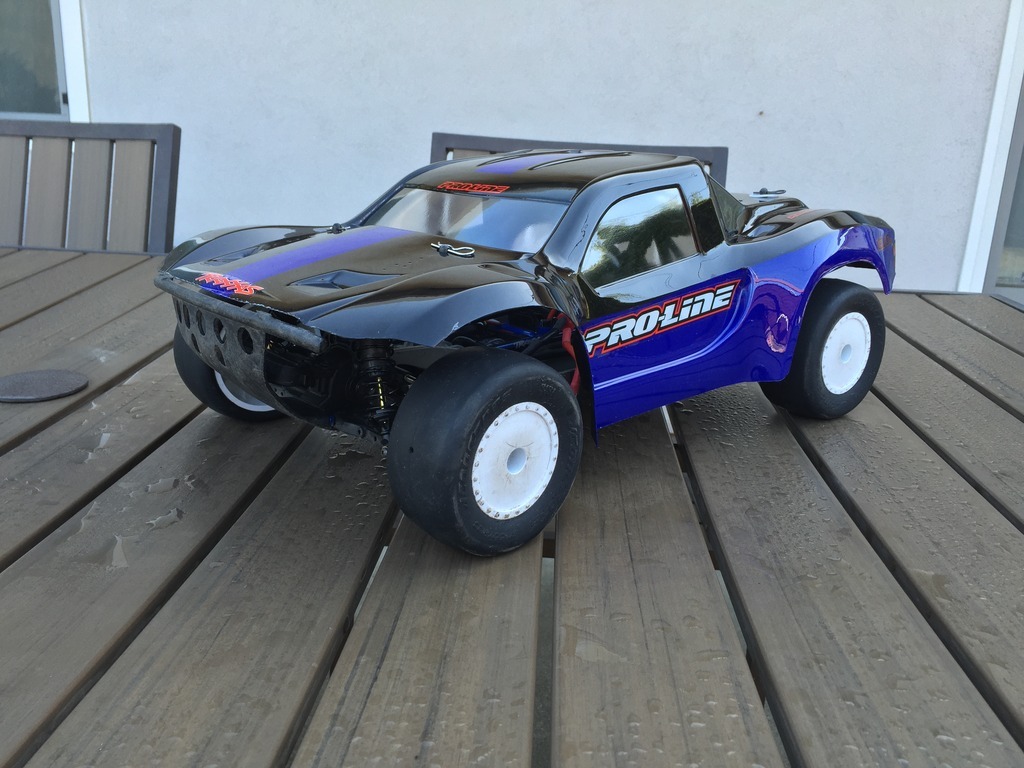
Painted up a new body for the Slash 4x4.  It’s a Pro-line Evo SC.  It doesn’t fit quite right, the front sticks out too far and basically has to be cut off, but the rest of the body seems good.  I sprayed it with some truck bedliner on the inside to make it a bit more durable.
The color scheme of purple and black with white and red accents came out pretty cool-looking!

Sanwa/Airtronics MX-V LiFe battery

image

I spent 20 minutes installing a LiFePo4 battery in MX-V transmitter.  The radio comes with a 4AA battery holder stock, but it’s basically meant to let you use a battery.

Conversion was pretty easy, you just need a Futaba connector kit and crimp tool.  LiFe batteries are much safer than LiPo batteries and run at 6.6v, so they’re a nice battery type for radios.  You don’t have to worry about leaving them charged or discharging them too low, just keep it above 5v.

I find the LiFe batteries last a really long time between recharge, so skip out on AA’s and get a LiFe!

Wednesday, March 9, 2016

GTR shock testing

I spent a few hours testing my new shocks, and have to say they are working awesome.  The front isn’t slamming down on the ground like before, I’ve pretty much settled on black front SCTE springs in the front, and blue front SCTE springs in the rear.  I still need to play with shock positions and oils, but this is getting pretty close.

Another issue that came to my attention is that the stock servo saver can’t keep up with high-traction situations.  I have a brand-new steering rack, including spring, and it still gives on the track when running slicks.  I never noticed this before with black wheels, because you can’t really see what the wheels are doing, but with white dish wheels it’s super-obvious and you can clearly see the wheels wandering mid-corner as the servo-saver gives and catches.

I’ve gone to a full STRC aluminum bellcrank system and it’s working great even with the servo saver backed off all the way.  You definitely need to make sure you’re using a metal servo with the bellcranks, because they don’t give as much as the plastic Traxxas one.  It’s amazing how much better the steering is, the precision is night and day.  Highly recommended if you are running on high-traction surfaces.

Rear GTR shocks on the front

I did the rear shock tower mod on the front as detailed by others, and put full rear GTR shocks (0 limiters) on.  The main issue with the rear shock tower is that it’s 17mm wider than the front shock tower, which means your shocks are mounted out way too far, especially when considering the taller mount.  Extrapolating from the stock shock positions, with the taller tower you would want to mount the shocks even more inward on the tower!

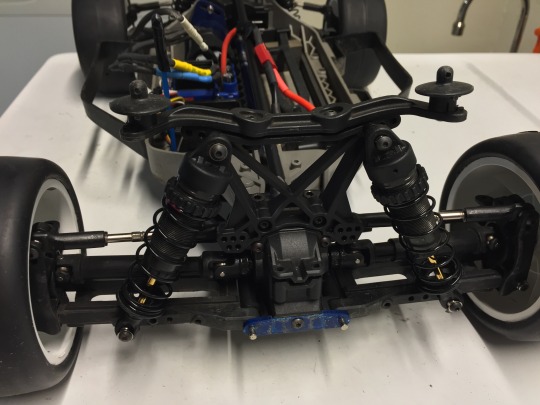
Most RC cars have the front shocks laid down flatter in the front than the rear.  Going to a rear shock tower makes that more difficult.  To combat this, I mounted the top shocks all the way inward, and the arm mounts all the way out.  It’s still too vertical for my liking, but that’s the best I can do at this point.


image


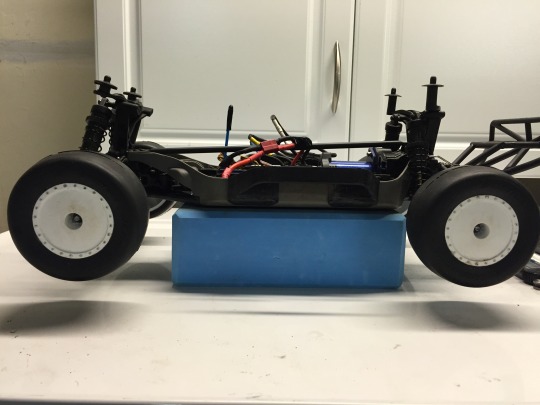
This also got my droop about where I wanted it front and rear.  At full extension, my wheels are about the same front and rear, with the front slightly higher (6mm) than the rear.  I don’t recall the stock droop on the front, but it was something like 14mm shorter than the rear, which is a massive difference.  I now have 42mm of shock travel at full extension, which should soak up the jumps much better than before.


image


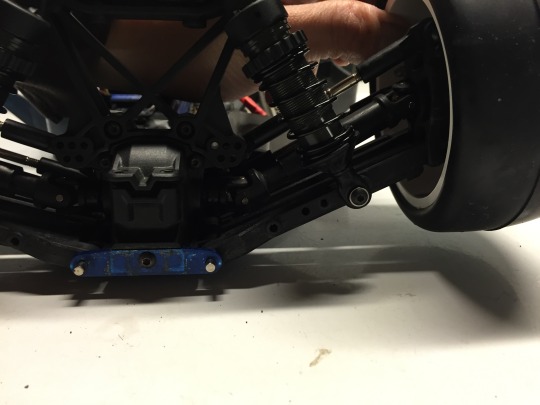
And the one thing I don’t see people talk about when mounting long shocks on the front is the compression distance on the front arms.  Thisis why you pretty much have to use a taller shock tower on the front when using longer shocks.  You need the wheel to be able to compress past the bottom of the chassis so that you have some additional room when landing cockeyed on a front wheel.


image


Even with the chassis bottomed out, the front wheels still have room to give.  You need this, else your shocks will get slammed when landing off-center a little bit.

Sunday, March 6, 2016

Slash front shock issues

There are a few things I don’t like about the design of the Slash, the main one that bugs me is the front shocks.
The Slash 4x4 uses the same shocks as the Slash 2WD, which uses the same shocks as the Rustler and Bandit.  Those vehicles are a lot lighter than the Slash 4x4 and have typical, short, buggy-length front shocks.
Well, that just doesn’t cut it on a 4x4 short course truck.  Traxxas maintained the short shocks for obvious manufacturing and parts reasons, but also to keep a short shock tower to fit under the hood of a short course body and not look ridiculous.
This has compromises in performance.  Let’s talk about them more:
1. Limited spring selection.  The GTR shocks are 13mm bore, and pretty much the only decent spring selection is Losi SCTE shock springs.  These fit the rear shocks pretty well, but are too long for the front.  There are GTR springs, but I have some issues (described below) with them.
2. Minimal droop.  This bothers me the most.  The LCG chassis is very low to the ground, only 23mm off the ground with arms level, which is overly short for a heavy short course truck.  Standard buggies are about 24mm of ride height, and they have smaller wheels!  So clearly 23mm of clearance is not going to cut it.  In addition to this, the front shocks barely extend far enough to give any droop, which means you have very limited shock extension in the air to absorb landings.  As a compromise, you have to use fairly stiff springs and pretty heavy oil to avoid chassis slap on pretty much any sort of jump.
3. Weak GTR springs.  I find the GTR springs wear out pretty fast and sag quickly.  I’m not sure if it’s spring quality or what, but they don’t last very long in my experience.  Being able to use longer springs that still fit should provide more consistency.
4. This is just a theory at this point, but I believe this also exacerbates the nose-dive situation of the truck.  The Slash 4x4 nosedives a LOT, partly because the front shocks cannot extend very far when jumping off a ramp.
I tried to fix 2. by shortening the rear shocks to have roughly equal droop front and rear, but that was more of a band-aid solution.  It kept the front and rear balanced at least and the car drove very flat, but the chassis slapped way too easily with the limited droop. I just recently found out about 3., and 1. was an issue, but I was getting by with using GTR blue springs.
The next post will detail how I am going about addressing these issues.