Friday, August 19, 2016

MIP lightweight TLR 22 race topshaft review (MIP16030)

(Stock topshaft on left, MIP topshaft on right)

I picked up an MIP all-aluminum topshaft for my 22T 2.0.  It was pretty cheap and I’ve been looking for ways to add speed for not a lot of money, so at $12 this was a cheap buy.

The MIP topshaft improves on the stock topshaft in a couple of ways.  It’s all aluminum instead of a two-part aluminum topshaft and steel threaded rod like the TLR part.  I’ve had the threaded rod back out on me before, so having a one piece design is nice.  It’s also 1 gram lighter than stock and has cut gears, so it should be slightly faster than the stock topshaft.

The final nicety is that it uses a standard M5 locknut so you can use your 7.0mm nut drive on it to make adjustments.  The stock nut is so small, I found that at tight slipper settings it would tweak the angle of the spring a little bit and not apply even pressure on the slipper plates.  With the thicker threading and bigger nut, I find the spring works a little more consistently.

Here it is mounted with my Avid slipper and garodisc pads:

Tuesday, August 16, 2016

Reedy Sonic 540-M3 Short Stack 17.5t/13.5t review

I had a Sonic Mach 2 17.5t in my B5, and it was a decent motor, but the 17.5 M3 short stack motor I used in my B5M Lite was a beast.

For the 22T 2.0, I tried a couple of 13.5t motors, and wasn’t really happy with any of them.  I had an Atomik RC Redline motor and a Team Powers Actinium, but they always seemed slow.

Since I had good luck with the 17.5t, I decided to get a 13.5t SS for my 22T 2.0, and wow, this thing is a monster.  It flat out rips.  It’s probably faster than my Atomik 10.5t motor.

Jumps I could barely clear, I’m now over-jumping by 1-2 feet.  The front straight features a small rise that I would wheelie a couple of inches on my buggy.  On my stadium truck, it’s doing full back-flips if I don’t let off the throttle.  I’m going to have to put a wheelie-bar on it!

The latest generation of Reedy motors have been awesome in my experience, and they’re also one of the more cost-effective at $90 (or less).  Bang for the buck, I don’t think you can beat them.

The solder tabs are a little large though – I had to cut off the corner of the A-tab to get it to fit in my truck, other than that I’ve been very happy with this series of motors.  Quality is great, performance is awesome, price is good, replacement parts are available, and support is good.

If you’re building a spec race car on a budget, this is definitely a motor to consider.

Reedy in a TLR?  It doesn’t quite fit, so you have to trim down the left-most solder tab a bit.

More speed please!

My 22T 2.0 is working well in the handling department, but it’s always been pretty slow speed-wise.  I got a few goodies recently to remedy that that I’ll be reviewing in the next few posts.

Thursday, August 11, 2016

MIP Super Diff Bi-metal kit review (B6)

I needed to rebuild the diff in my B6 (it was the one I ran in my B5M), so I decided to upgrade to the MIP super-diff with bi-metal outdrives.  Cost was $41, or about $20 more than a diff rebuild kit, so it makes it a pretty good deal.

The bi-metal outdrives consist of aluminum diff ring holders that mate into steel outdrives.  This gives you the combination of a lightened diff with the durability of steel outdrives.  I considered getting the full pucks system with aluminum outdrives, but the increased maintenance made it unappealing.

The bi-metal outdrives alone drop the weight by about 0.3 oz. (8.5 grams).

image
image

It’s a nice little upgrade.  The weight is also reduced where it affects the most, which is furthest away from the centerline.  A nice bonus is that when you need to replace the outdrives, you can replace just the steel part.  You don’t even have to remove your diff to do this, you can leave it in the transmission on the car!

Testing it on the track, it felt like my B6 had much more acceleration.  Jumps that I could barely clear before, I could mess up the approach and still clear.  I’d say the acceleration/power difference was about 10%, or about the difference of the slipper eliminator.

Pretty slick and a nice upgrade.  If you reuse your existing diff rings/balls/thrust, you don’t have to get the whole super-diff bi-metal kit, you could just buy the aluminum diff hubs and steel outdrives and save a few dollars.

Wednesday, August 10, 2016

Tamiya Hornet mods

I’ve made a few changes to the Hornet to improve it a bit.  First of all, there is a limited selection of tires, so I got the hex conversion for the rear wheels.  It basically uses an aluminum spacer to take up the offset that the regular wheels have and lets you use modern buggy wheels.


It doesn’t leave a lot of threads for the thickness of the wheel.  I took a look at DE Racing, AKA, Kyosho RB6, Pro-line, Jconcepts and Associated B6 wheels, and the Associated wheels were the thinnest.  They leave about 5 threads on the axle for the nut, and I recommend sticking with these to get the maximum amount of material for the nut to thread onto.  Here are some Dirt Hawg tires I’m using for the street.


I’ve also been playing with the suspension on the buggy to get it to work a little better.  One of the main weaknesses of the Hornet is that it is super light on the front of the buggy and very heavy on the rear.  I had a 35g TLR brass weight lying around that fit perfectly on the front end above the axles.  The weight softens up the front end so it’s not quite as bouncy and a little more plush.  You can use lead tire weights or whatever, but I recommend putting some weight on the front end because it is crazy light there.

Saturday, July 30, 2016

Tamiya Hornet at the track

I threw some slicks on the back of my Hornet and took it to the local track to see what it could do just for the heck of it.

Initial thoughts: 

  • The stock motor is slow, but decent enough for the Hornet.  There were only two small jumps I could make, the rest I had to roll over.
  • High traction is not its friend.  The Hornet is tall and narrow, and traction rolls easily.  It works better in low traction.
  • Stock springs are too stiff.  Damping is probably OK, but the front springs are way too stiff.  Rear springs are too stiff with the preload spacer, definitely take those off.  A lot of people say the springs are too soft and that’s why it’s bouncy, but actually the opposite is true:  the springs are too stiff.
  • Ride height is too tall.  The buggy is very light, especially in the front, and with stiff springs it sits all the way up all the time.
  • Braking is OK with the stock ESC and there is tons of weight on the rear, so the rear end doesn’t break loose, but with the very light diff action the steering can get pretty squirrelly.

I’m going to work on suspension a little bit, softening the springs and running a lower ride height should help.

Monday, July 25, 2016


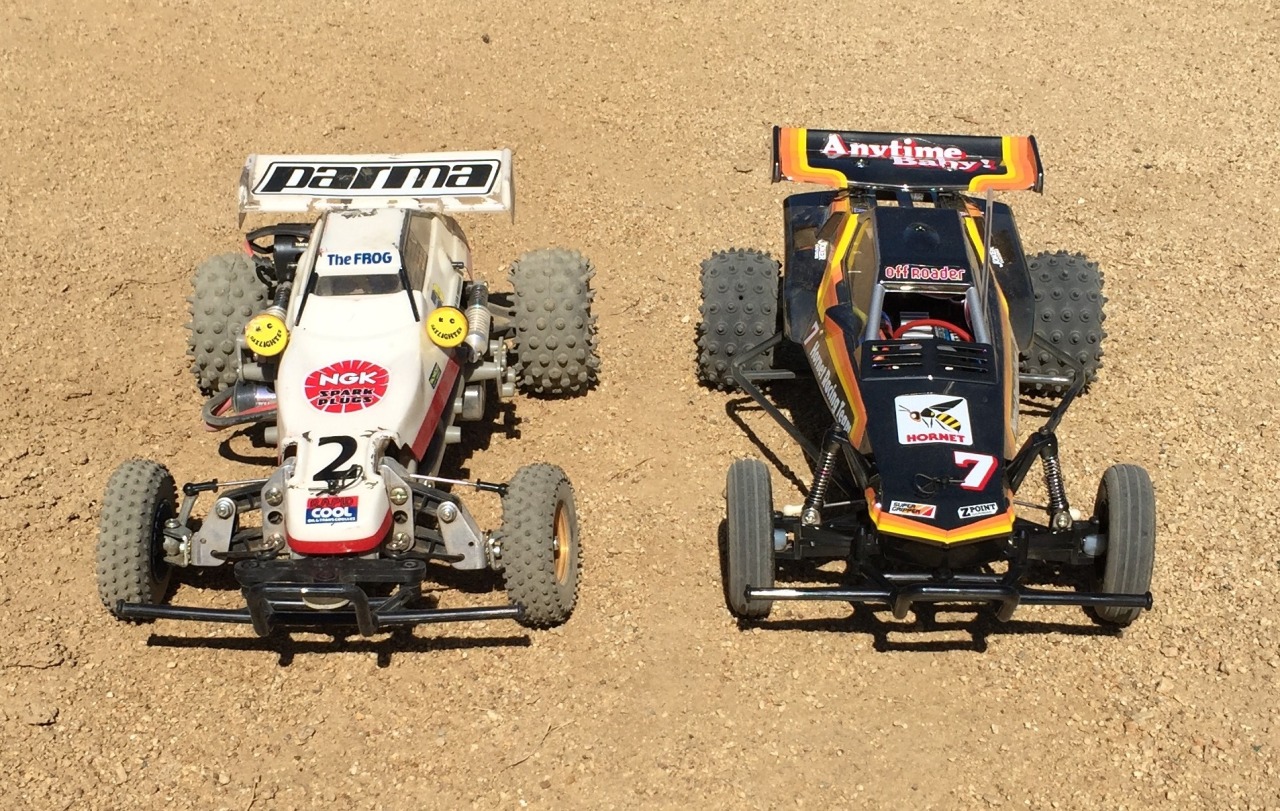
Tamiya Frog (1983) vs. Tamiya Hornet (2016)
This is my neighbor’s original Frog from back in the day and my re-release Hornet.  The Frog’s been upgraded to an ESC, modern Hitec servo and an RS540 Sport Tuned motor on Nimh.  My Hornet is box stock with a Traxxas servo running on 2S Lipo.
The Hornet is faster, must be the battery!